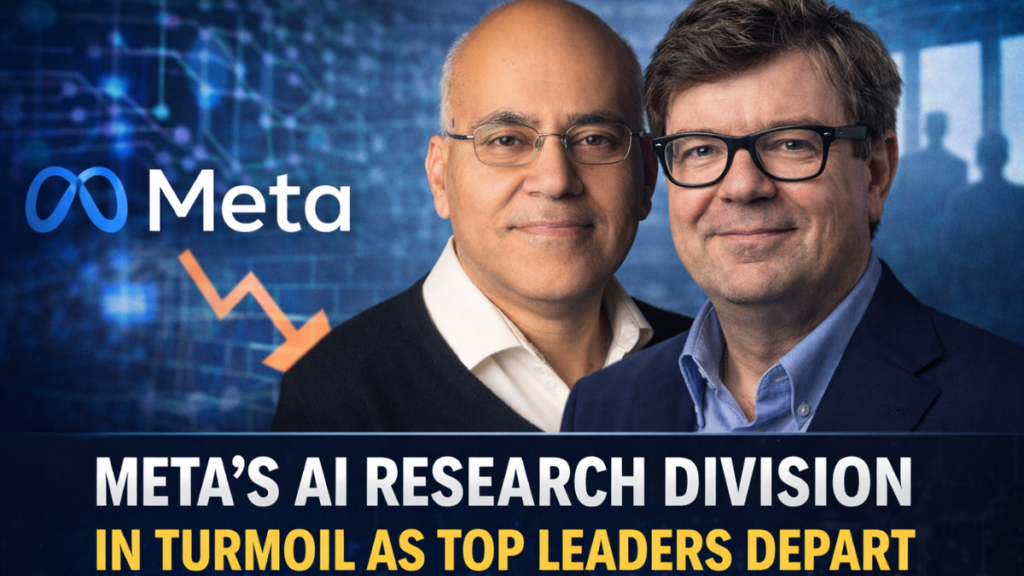
Meta, the company behind Facebook and Instagram, is facing some serious changes in its artificial intelligence (AI) team. Several senior leaders are leaving and many inside the company are describing this as ‘dying slow death’ as Meta is aggressively favoring commercial AI products.
The latest exit is Jitendra Malik, a senior leader in Meta’s AI research division. He has stepped down to join Amazon’s robotics research team in San Francisco. His departure is not just another resignation, it adds to a growing list of top AI experts walking away from a team that was once considered one of the best in the world.
From World-Class Lab to Uncertain Future
Meta’s AI research unit, earlier known as FAIR (Fundamental AI Research), was once famous for groundbreaking work in machine learning and computer vision. But according to several insiders, the lab has slowly lost its direction as Meta shifted its focus from long-term research to faster, product-driven AI projects.
This shift became more visible after Yann LeCun, Meta’s Chief AI Scientist and a global leader in AI research, left the company in November 2025. LeCun, who has spent decades shaping modern AI, exited as Meta began prioritizing large language models, the kind of AI used in chatbots and content tools.
LeCun Speaks Out
LeCun did not leave quietly. In recent interviews, he openly shared his concerns about Meta’s heavy focus on quick AI products and short-term results. He argued that true intelligence in machines needs deeper research into reasoning, memory, and learning – not just better chatbots.
After leaving Meta, LeCun launched his own AI startup while continuing his work as a professor at New York University. He also questioned Meta’s decision to put younger, product-focused executives in charge of research teams, saying it created tension between researchers and leadership.
A Bigger Talent Drain
Malik’s exit follows a broader trend. Over the past year, several key researchers who helped build Meta’s AI reputation have also left. Experts believe Meta is moving away from open-ended research and instead focusing on AI products that can directly compete with companies like OpenAI and Google.
As part of this shift, Meta has gone through layoffs, restructured teams, and launched a new unit called Meta Superintelligence Labs, aimed at developing advanced AI systems under a new leadership setup.
What Meta Says
Despite the high-profile exits, Meta has played concerns around leadership departures and internal turmoil. The company has not issued any specific public statement addressing Malik’s resignation or LeCun’s exit. However, Meta has repeatedly said that AI remains a core priority and that it is restructuring teams to bring research closer to real-world products.
In recent communications around its AI reorganization, Meta has maintained that it is investing heavily in artificial intelligence, including the launch of Meta Superintelligence Labs, a new unit focused on advancing next-generation AI systems. The company has framed these changes as part of a broader effort to move faster and stay competitive in the global AI race, rather than a retreat from research.
Meta has not publicly responded to criticism from former researchers regarding cultural shifts or leadership decisions.
What Lies Ahead for Meta’s AI Ambitions?
While Meta continues to invest billions in AI, the departure of respected leaders like LeCun and Malik raises important questions. Can Meta still lead in deep, foundational AI research or will it focus mainly on fast, market-ready AI tools?
For now, one thing is clear: Meta’s AI team is at a turning point, and how the company balances innovation with commercial pressure will define its next chapter in the AI race.