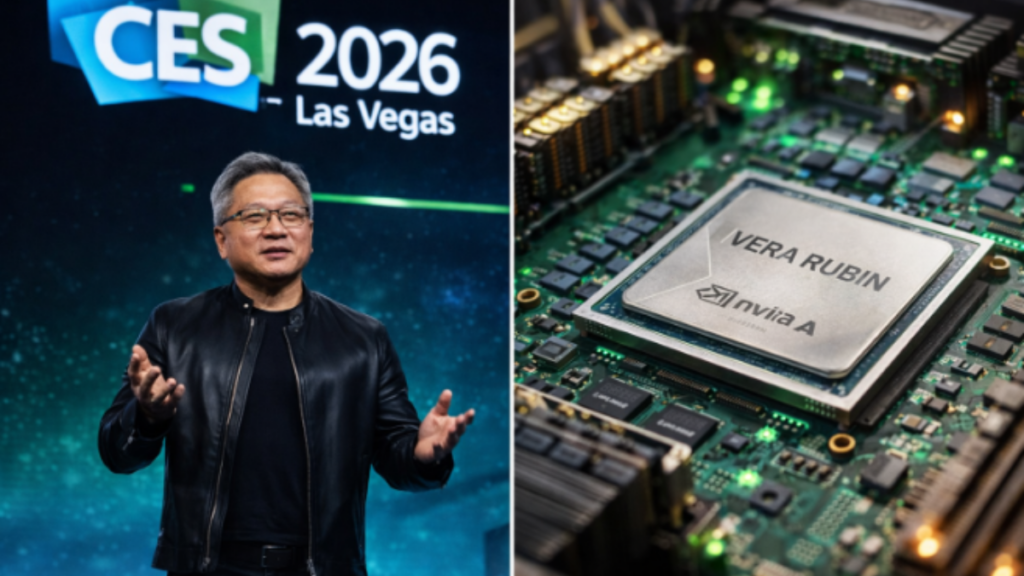
Las Vegas: Nvidia, the world’s leading artificial intelligence (AI) chip maker, has announced that its next generation of AI chips is now in full production, marking a significant step forward for the AI industry. The announcement was made by Nvidia’s founder and CEO, Jensen Huang, at the Consumer Electronics Show (CES 2026) in Las Vegas, one of the biggest technology events in the world.
Speaking on Monday, Huang said the new chips- part of Nvidia’s Vera Rubin platform- are already being manufactured and tested and are expected to reach customers later in the year. According to the company, these chips can deliver up to five times more AI computing power compared to Nvidia’s previous generation when running large AI applications such as chatbots and language models.
The Vera Rubin platform is made up of six different components, including advanced graphics processing units (GPUs) and central processing units (CPUs), which together form a powerful AI system for data centers and large-scale AI tasks. Nvidia showed how multiple chips can be linked together to create powerful computing pods capable of handling complex AI workloads.
Nvidia also highlighted improvements in efficiency, saying the new chips can generate AI outputs- known as “tokens”- much faster and at lower cost than before. The company is positioning the platform as a key tool for cloud service providers, enterprises, and developers who rely on high-end AI computing.
In his speech, Huang explained that Nvidia has introduced new memory and storage technologies designed to help AI systems respond more quickly, especially for long and complex queries. He also noted that partners such as CoreWeave will be among the first to adopt the new systems and expected major tech companies to begin using them.
While Nvidia still leads the AI chip market, it faces growing competition from other companies such as Advanced Micro Devices (AMD) and Google, which are developing their own AI hardware. Nevertheless, Nvidia’s early move with the Rubin platform underscores its strategy to stay at the forefront of AI innovation.
The developments at CES 2026 reflect how companies are racing to build faster, more efficient AI computing infrastructure as demand for generative AI and large language models continues to grow globally.