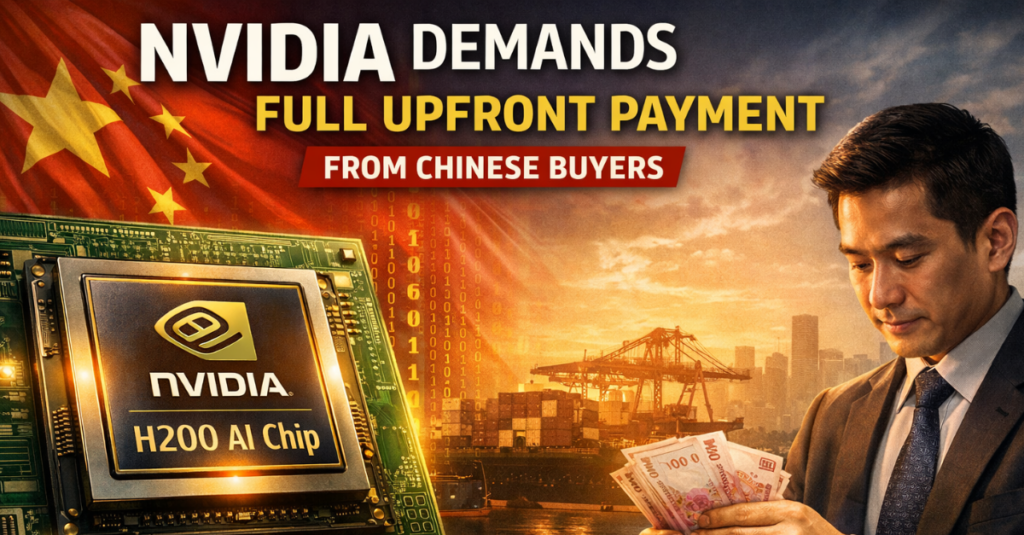
U.S. chipmaker Nvidia has tightened payment terms for its advanced H200 artificial intelligence (AI) chips sold to Chinese customers, requiring buyers to pay the full amount upfront before shipments are made, according to industry reports.
Under the revised terms, orders cannot be cancelled or modified once placed, shifting more financial risk to Chinese buyers. In limited cases, Nvidia may accept guarantees such as insurance or collateral instead of direct payment, though these exceptions apply only under special conditions.
The H200 chips are among Nvidia’s most powerful AI processors and are widely used for training and running large-scale AI models, including applications in data analytics and machine learning. Demand for the chips in China remains strong, even as regulatory uncertainty continues to delay approvals for shipments.
Industry observers note that the stricter payment requirements are linked to uncertainty surrounding Chinese government approvals for importing high-end AI hardware. By collecting payment in advance, Nvidia reduces its exposure to potential losses if shipments are delayed or blocked.
Despite the strong demand, Chinese authorities have reportedly asked some technology companies to temporarily pause new orders for advanced AI chips while regulators review policies governing their import and use. The move reflects Beijing’s cautious approach to balancing access to cutting-edge foreign technology with national security and industrial policy concerns.
China is also seeking to boost domestic semiconductor production and is reportedly evaluating measures that could require companies purchasing foreign AI chips to invest in or support locally manufactured alternatives.
The development underscores the growing complexity of the global AI hardware market, shaped by U.S.–China technology tensions, export controls, and supply-chain risks. For Chinese firms, the new terms mean committing capital upfront despite regulatory uncertainty. For Nvidia, the policy offers greater financial protection amid tightening controls. More broadly, it highlights how geopolitical factors are increasingly influencing the trade of advanced AI technology.